

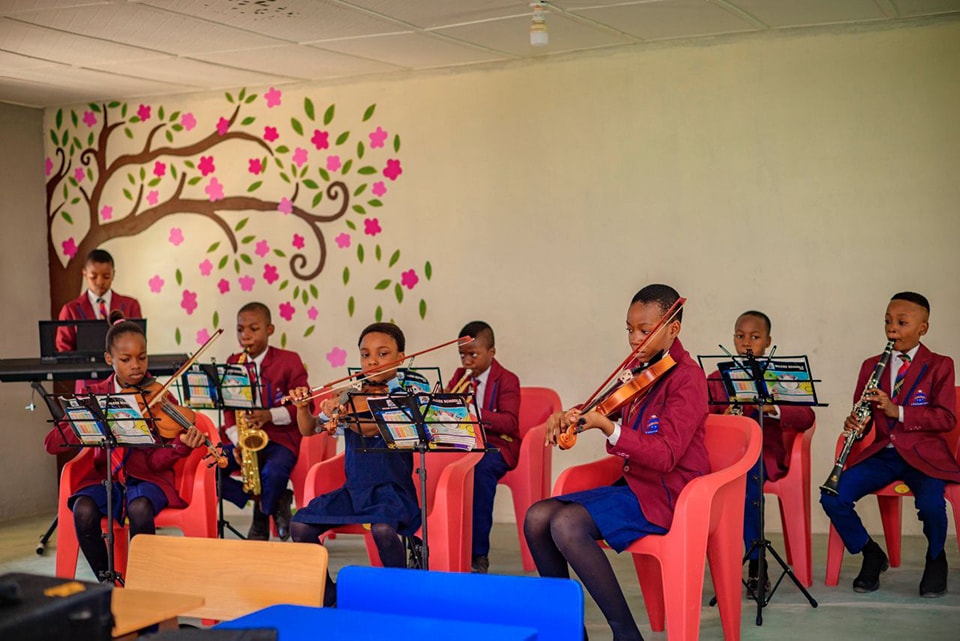
When the school day begins to wind down and the campus grows quieter, a different kind of learning comes alive at Wilcox Schools. In the music room—bright, calm, and full of curiosity our violin learners gather with excitement, each holding an instrument that feels both new and special.
At the beginning, many of them wear the same expression: joy mixed with a little nervousness. The violin is beautiful, but it can look complicated. So we start in the simplest, most confidence-building way with care, patience, and step-by-step guidance.
The First Step: Understanding and Respecting the Violin
Before we even try to play, we teach our learners how to carry the violin properly, how to place it safely, and how to treat it with respect. They learn the parts the bow, strings, bridge, fingerboard and why each one matters. It feels like meeting something important: you learn its name, its purpose, and how to handle it well.
They quickly discover that the violin is not just an instrument—it is a discipline.
Building a Strong Foundation
Next comes posture and balance. We guide them to stand (or sit) correctly: shoulders relaxed, back straight, chin gently resting, and hands positioned naturally. These small details are not just about music—they also strengthen focus, body awareness, and self-control.
We encourage them to breathe, listen, and try again when something doesn’t work. In those moments, they learn a quiet lesson that stays with them:
progress is consistency, not perfection.
The Bow: Learning Control and Confidence
Then comes the bow—every beginner’s first real challenge. We show them how to grip it gently, not too tight and not too loose, and how to move it smoothly across the strings. The first sounds are often squeaky and funny, and the room fills with laughter. Nobody is embarrassed, because we make it clear from the start:
“Every great violinist started somewhere.”
That single reminder helps them relax—and when they relax, they improve faster.
Finger Placement: Training the Ear and the Mind
Once they can produce a steady tone, we introduce finger placement. Learners practice pressing softly and accurately, learning that small movements create big changes in sound. This stage builds both precision and listening skills, because the violin rewards careful attention.
They begin to recognize correct notes, adjust themselves, and even support their classmates. Sometimes, a learner will pause, listen, and encourage a friend: “Try again—your finger is a bit too close.” That is learning, confidence, and teamwork all working together.
From Notes to Music: The Moment They Shine
Gradually, learners move from open strings to simple melodies—short tunes that feel like major victories. The first time they play a complete song together, something special happens. The music may be basic, but the achievement is huge. Their faces brighten, their posture improves, and you can almost see the confidence growing.
They realize:
“I can do hard things.”
That is the true goal—not only to produce music, but to build courage, patience, and resilience.
Practice Culture: Small Efforts, Big Results
We also teach healthy practice habits: short routines, warm-ups, repetition, and gentle correction. Learners learn to set small goals—master a line, improve a bow stroke, perfect a note. Over time, parents and teachers notice changes: improved concentration, stronger patience, better listening, and increased responsibility.
Performance: A Celebration of Growth
Whenever it is time to perform—during assemblies, school events, or small showcases—our learners step forward with pride. Some play smoothly, others play simply, but every learner stands confidently because they know they worked for that moment.
And long after the last note fades, what remains is bigger than the song:
discipline, confidence, and the joy of achievement—one note at a time.
At Wilcox Schools, teaching violin is more than teaching music. It is teaching our learners to believe in steady progress, embrace mistakes as part of learning, and turn effort into excellence.